SECTION
Problem & Solution
Why most funnels fail, and the simple shift this system introduces.
PROBLEM
Static funnels
Most products push everyone through the same journey, even when intent and readiness are clearly different.
High-intent users get slowed down by generic steps.
Low-intent users get pushed too hard and bounce.
Teams tune one funnel for everyone.
Problem
Funnels break at the exact moment intent matters most.
!
One path for everyone
High-intent users get slowed down. Low-intent users get pushed too hard.
!
Teams react too late
Dashboards tell you what happened. They do not help in the moment.
!
Logic is fragmented
Popups, emails, onboarding and CRM rules are not coordinated.
Most teams can improve one stage. Few can coordinate the whole journey.
Solution
One decision engine that adapts the journey with guardrails.
1
Signals captured
Track sessions, events, product views, friction, and drop-off hints.
2
Intent inferred
Lightweight AI helps summarize intent and blockers, then hands off to rules.
3
Next action decided
Pick the best nudge, offer, or path based on stage, constraints, and caps.
4
Guardrails and logging
Rate limits, suppression rules, experiment tags, and full audit trail.
THE KEY SHIFT
Instead of building separate rules per tool, one engine decides the next best move and then triggers the right channel.
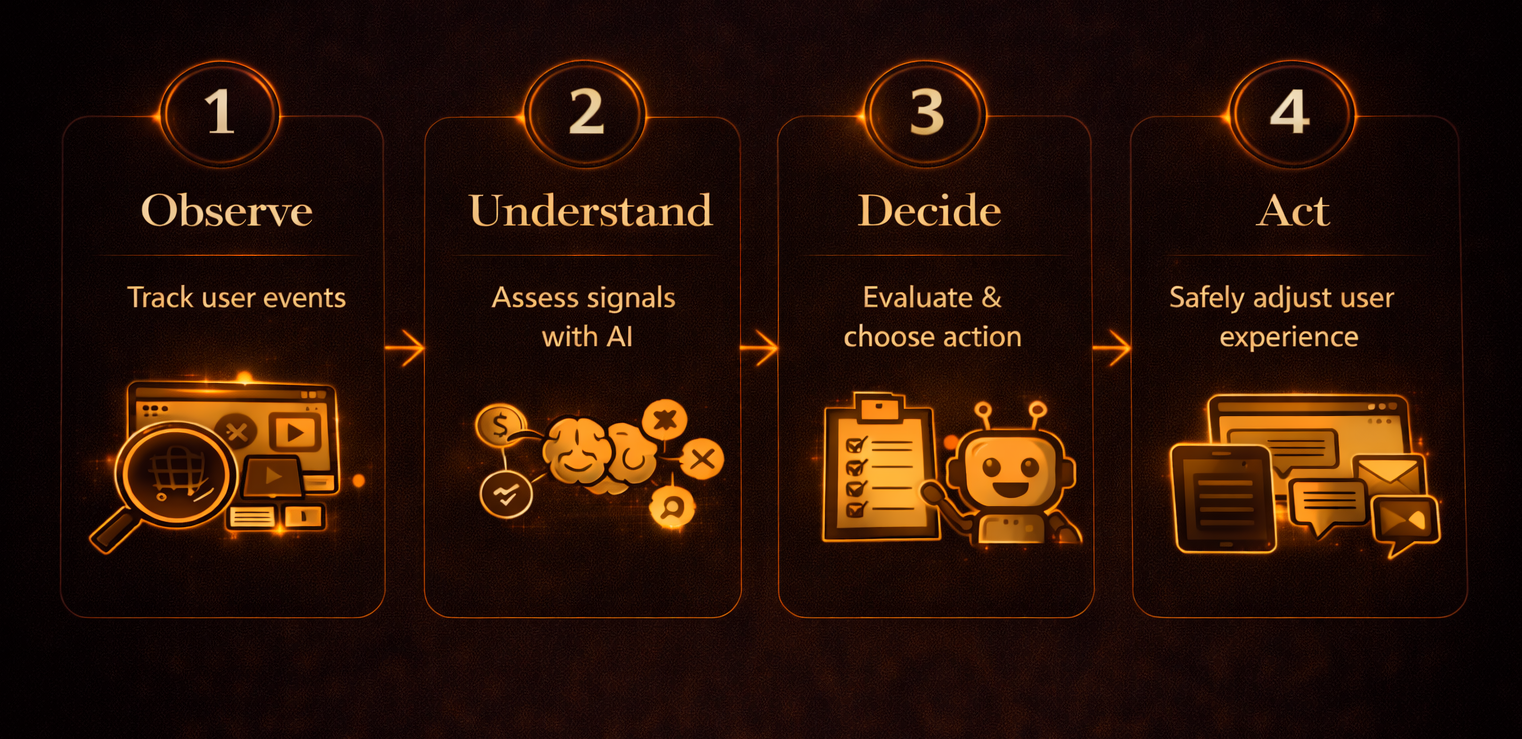
01
System step
Observe
Capture real user signals across the journey, not vanity metrics.
Uses
- Sessions, events, and page depth
- Product views, cart actions, checkout starts
- Account state: trial, paid, cancelled, reactivated
Produces
- Clean event stream per user
- Derived signals like drop-off point and recency
GuardrailOnly track what you can explain and audit.
FLOW SIMULATIONS
Simulated walkthroughs
Story style walkthrough
Choose a scenario. Then step through the story to see how signals change the decision and what the user actually sees.
Visitor to signup
Acquisition•Step 1 of 4
Click a segment to jump
01Step 1 of 4
On-site
Detect intent
Signal
Repeat product views, long dwell time, comparison clicks, pricing page revisits.
Decision
This user is evaluating seriously. Reduce uncertainty, not price.
Action
Surface social proof + delivery clarity + one simple CTA. Avoid discount.
User sees
Quick reassurance
Top reviews, delivery ETA, and a single ‘Get 10 min setup’ CTA on the product page.
Demo is simulated. The goal is to show decision logic and the visible experience.
Demo placeholder
Embed a Loom or interactive prototype here later.
Now
Slide 1 of 3
Click a segment to jump
Get the foundation in place with clear control points.
Rule based baseline
Simple diagram
Excalidraw style placeholder for now. Replace with a real system diagram later.
Focus
- Track the right events and make intent visible.
- Ship a simple rules engine that stays explainable.
- Add audit logs so every change is traceable.
What ships
- Event schema + naming conventions
- Intent rules for 3 to 4 core journeys
- Per user caps, throttling, suppression windows
- Audit log for decisions and actions
Guardrails
- Hard caps per user per day
- No discount by default
- Kill switch per channel
- Human override for high risk actions
The point of this roadmap is sequencing. Each stage keeps measurement and control, so you do not jump into black box personalization too early.